

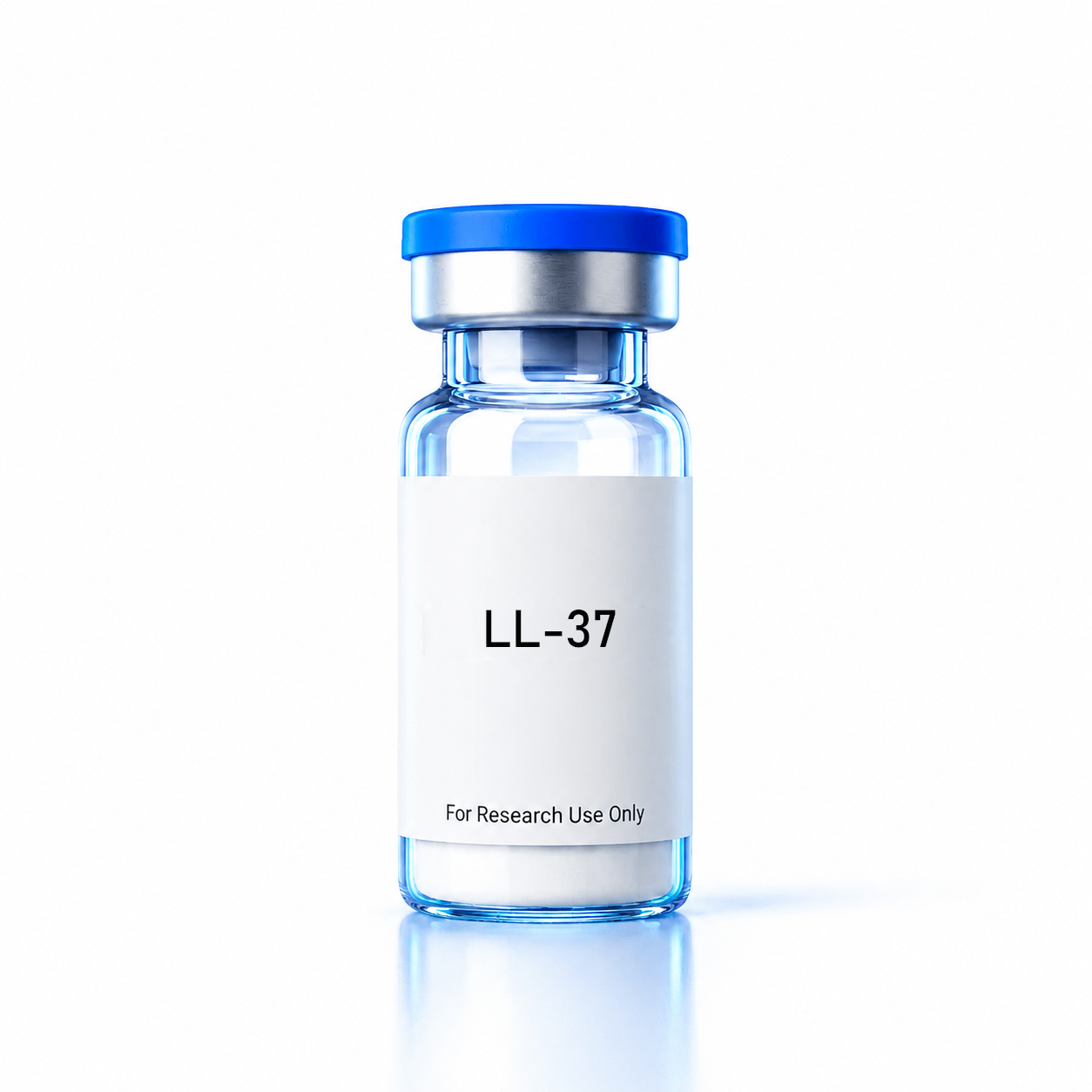
LL-37 (Human Cathelicidin)
⚠️ Disclaimer: For Research Use Only. Not for human administration or clinical therapy.
Basic Information
- CAS No.: 154947-66-7
- Amino acid sequence: LLGDFFRKSKEKIGKEFKRIVQRIKDFLRNLVPRTES (37 amino acid residues)
- Molecular Formula: \(\boldsymbol{C_{205}H_{340}N_{60}O_{53}}\)
- Molecular Weight: 4493.33 g/mol
- Appearance: White to off-white lyophilized powder
- Properties: Cationic amphipathic α-helical peptide; net charge +6 at pH7; pI ≈10.5
- Solubility: Soluble in sterile water / bacteriostatic water, weak aqueous buffer
- Storage: Lyophilized powder stored at -20℃, protected from light and moisture, avoid repeated freeze-thaw cycles. After reconstitution, refrigerate (2–8℃) and use promptly.
Development Background
LL-37 is the only human cathelicidin antimicrobial peptide (AMP). It is the C-terminal 37-amino-acid fragment cleaved from the precursor protein hCAP-18 encoded by the CAMP gene. It is naturally produced by neutrophils, keratinocytes and epithelial cells as a key component of human innate immunity. It was first identified at Karolinska Institutet.
Mechanism of Action (Research Findings)
- Broad-spectrum antimicrobial activity: Cationic peptide electrostatically binds negatively charged microbial membranes. Disrupts lipid bilayer via carpet / toroidal pore model, kills Gram-positive, Gram-negative bacteria, fungi and enveloped viruses. Less prone to induce drug resistance compared with traditional antibiotics.
- Endotoxin neutralization: Binds and neutralizes LPS, suppresses LPS-triggered pro-inflammatory cytokine release (TNF-α, IL-6).
- Immunomodulation: Regulates innate immune response; can recruit immune cells and balance pro/anti-inflammatory signaling.
- Wound healing & tissue regeneration: Promotes keratinocyte migration, angiogenesis and re-epithelialization, accelerates skin/mucosa repair.
- Additional bioactivities: Antibiofilm, anti-tumor research, cell-penetrating properties.
Research Areas
- Antimicrobial & anti-biofilm research (including multi-drug resistant pathogens)
- Endotoxin / LPS inflammation model
- Wound healing, skin and mucosal tissue repair
- Innate immunity and immunoregulation
- Antiviral and antifungal studies
- Cancer biology and cell signaling research

评价
目前还没有评价