

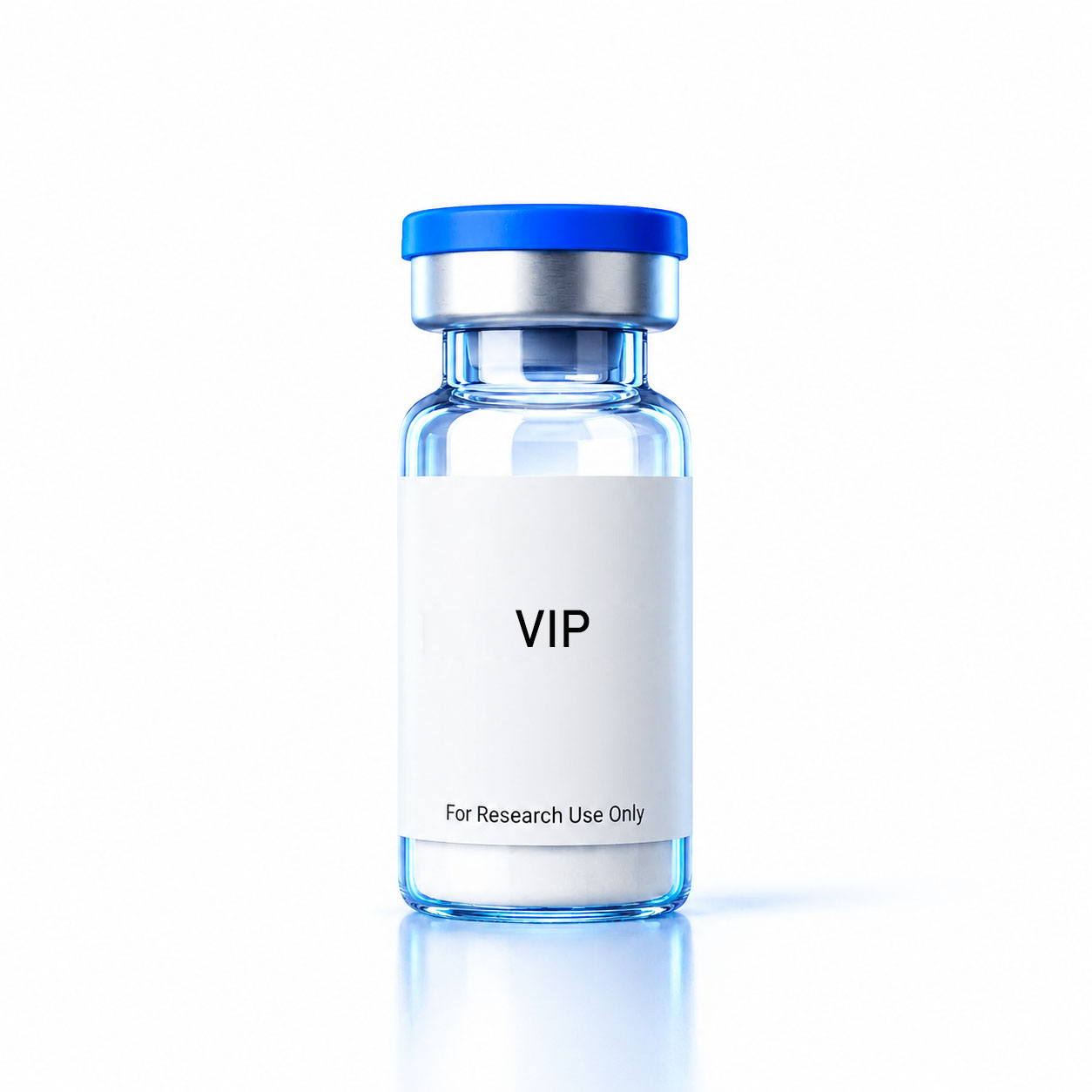
VIP (Vasoactive Intestinal Peptide)
⚠️ Disclaimer: For Research Use Only. Not for human administration or clinical therapy. Alias: Aviptadil, VIP-28
Basic Information
- CAS No.: 40077-57-4
- Amino acid sequence: His-Ser-Asp-Ala-Val-Phe-Thr-Asp-Asn-Tyr-Thr-Arg-Leu-Arg-Lys-Gln-Met-Ala-Val-Lys-Lys-Tyr-Leu-Asn-Ser-Ile-Leu-Asn-NH₂ (HSDAVFTDNYTRLRKQMAVKKYLNSILN-NH₂), 28 amino acid neuropeptide
- Molecular Formula: \(\boldsymbol{C_{147}H_{237}N_{43}O_{43}S}\)
- Molecular Weight: 3326.8 g/mol
- Appearance: White to off-white lyophilized powder
- Solubility: Soluble in bacteriostatic water and aqueous buffer
- Storage: Lyophilized powder stored at -20℃, protected from light and moisture. Avoid repeated freeze-thaw cycles. After reconstitution, refrigerate and use promptly.
Development Background
VIP belongs to secretin/glucagon superfamily. It was first isolated from porcine small intestine by Said and Mutt in 1970. Human, porcine and rat VIP share identical amino acid sequence. It is an endogenous neuropeptide synthesized by neurons, immune and epithelial cells across brain, gut, lung and immune tissues. The synthetic pharmaceutical form is named Aviptadil.
Mechanism of Action (Research Findings)
- Binds to two G-protein coupled receptors VPAC1 and VPAC2, elevates intracellular cAMP level.
- Potent vasodilation & smooth muscle relaxation: relax blood vessel, bronchial and gastrointestinal smooth muscle.
- Anti-inflammatory & immunomodulation: suppress pro-inflammatory cytokines (TNF-α, IL-6), induce Treg cells, maintain immune tolerance.
- Neuroprotection & neuromodulation: regulate synaptic plasticity, reduce neuroinflammation.
- Gastrointestinal regulation: inhibits gastric acid secretion, stimulates pancreatic bicarbonate release, modulates gut motility.
- Minor antimicrobial activity against bacteria and fungi.
Research Areas
- VPAC receptor pharmacology & GPCR signaling study
- Vasodilation, pulmonary hypertension & lung injury models
- Autoimmune disease, neuroinflammation and immune tolerance research
- Gastrointestinal secretion and motility research
- Neuroprotection and central nervous system inflammation
- Sepsis, ARDS and tissue inflammatory injury models

评价
目前还没有评价