

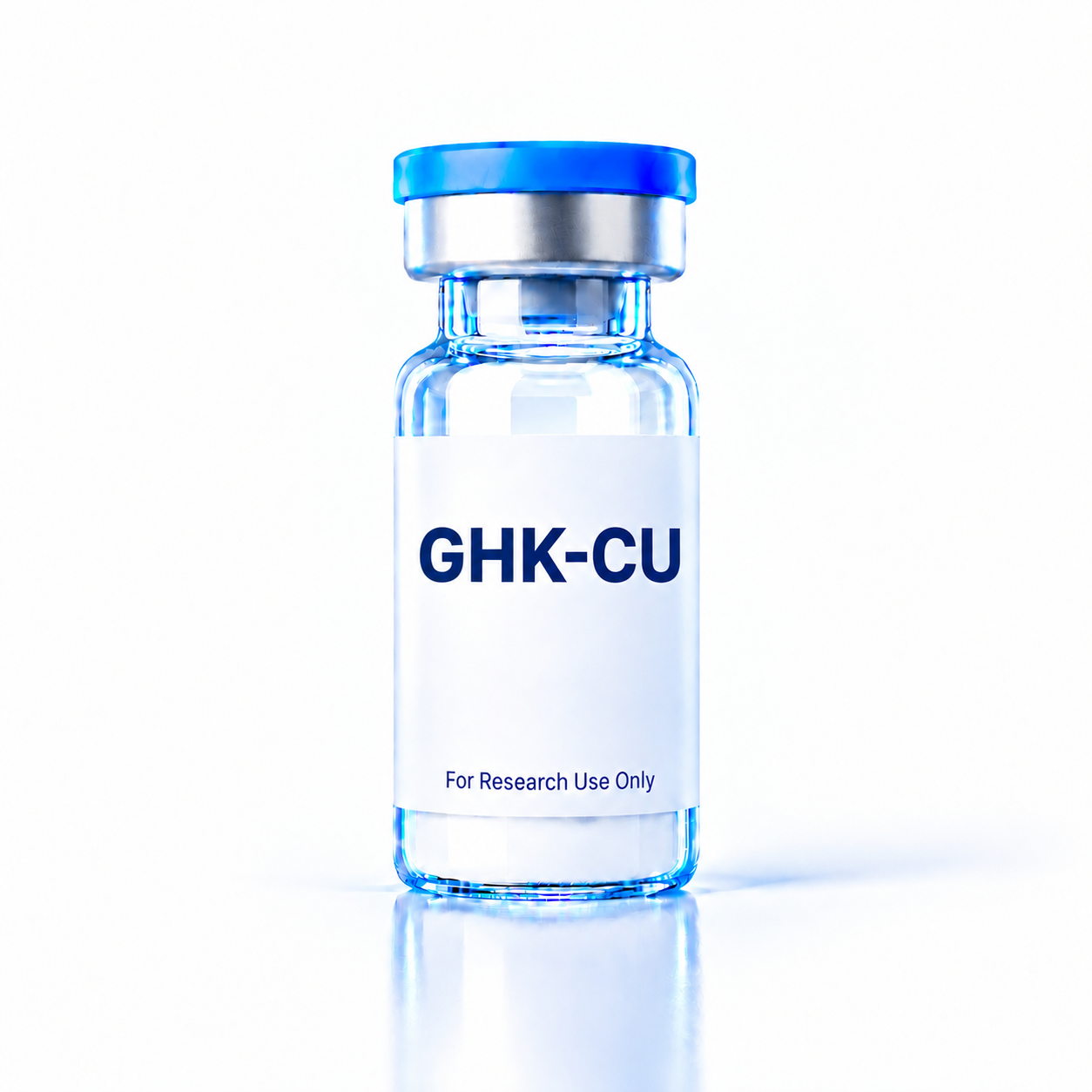
# GHK-Cu (Copper Tripeptide-1, Blue Copper Peptide / Copper Tripeptide-1)
CAS: 49557-75-7 (GHK-Cu complex); Free GHK tripeptide CAS: 72957-37-0
> Synonyms: Prezatide Copper, Glycyl-L-histidyl-L-lysine copper (II) complex
> ⚠️ Research grade is for laboratory research only; cosmetic grade is for topical skincare products and must not be injected into the human body
## Basic Information
– Amino acid sequence: Gly-His-Lys (GHK), chelated with divalent copper ions Cu²⁺ in a 1:1 ratio
– Molecular formula: \(\mathbf{C_{14}H_{22}CuN_{6}O_{4}}\)
– Molecular weight: 403.9 Da (complex; free GHK: 340.4 Da)
– Properties: Lyophilized powder appears pale blue/blue-violet; aqueous solution is characteristically sky blue
– Source: An endogenous tripeptide first isolated from human plasma; its levels in the body decline with age
Mechanism of Action (Research Focus)
Regulation of tissue remodeling through multiple pathways; does not bind to a single receptor:
1. Promotes matrix synthesis: Upregulates fibroblasts; stimulates the synthesis of collagen, elastin, and glycosaminoglycans; reduces matrix metalloproteinases (MMPs) (which degrade collagen)
2. Anti-inflammatory + antioxidant: Scavenges reactive oxygen species (ROS); downregulates TNF-α and IL-6; modulates macrophage phenotypes
3. Angiogenesis + Wound Healing: Chemotaxis of endothelial cells, acceleration of epithelial healing, and enhancement of wound tensile strength
4. Gene Regulation: Reported in the literature to regulate the expression of thousands of genes; activation of SIRT1 for research in aging and tissue repair
5. Hair follicles, neuroprotection, and repair of lung/liver damage are all preclinical research hotspots
Physical and Chemical Properties & Dissolution Guidelines (Key Point: Metal-chelating peptides have unique stability characteristics)
– Solubility: Easily soluble in pure water and PBS; pH stability range: 4.0–7.0; strong acids and strong bases can break the Cu chelate bond, causing copper ions to precipitate and rendering the peptide ineffective
– Resuspension solvents: Sterile water, PBS; strong reducing systems are not recommended (as they destroy the copper complex structure); BAC water is acceptable, but high concentrations of preservatives may affect color stability during long-term storage
– Not suitable for mixing with strong reducing agents or high-concentration EDTA (EDTA chelates copper ions, inactivating GHK-Cu)
Storage Guidelines
– Lyophilized powder: Store sealed, protected from light, and in a dry environment at -20°C; stable for ≥2 years
– Reconstituted solution: Refrigerate at 2–8°C, protected from light; use within 4 weeks; aliquot and store at -20°C; avoid repeated freeze-thaw cycles; discard if color noticeably fades or precipitation occurs
Research Combination Recommendations
– Skin / Wound Repair: GHK-Cu + BPC-157 (the most classic repair combination)
– Neural and Anti-inflammatory Repair: GHK-Cu + ARA290
– Anti-Aging and Cellular Oxidative Stress: GHK-Cu + Epithalon
⚠️Important Notice
1. The cosmetic version is for external use only; the research-grade GHK-Cu must not be injected into humans and has not been approved for any human therapeutic indications involving injection.
2. Excessive copper ions pose potential toxicity risks; avoid prolonged exposure of aqueous solutions to strong light, as they are prone to oxidation and degradation.
3. All information is based solely on preclinical and chemical data for peptides and does not constitute any guidance for human use.

评价
目前还没有评价