

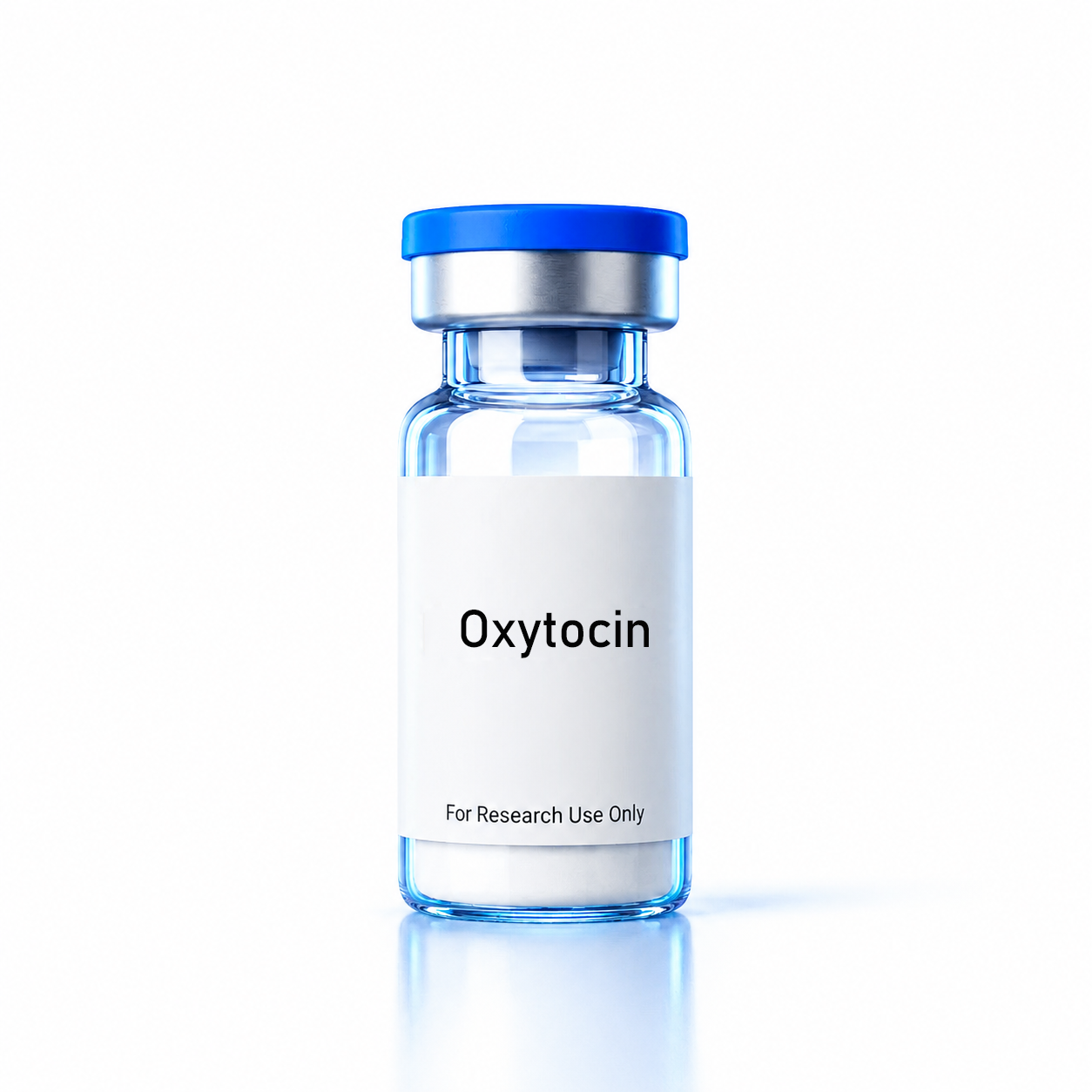
Oxytocin (OXT)
⚠️ For research use only. Not intended for human administration.
Basic Information
- CAS No.: 50-56-6
- Alias: α-Hypophamine, Pitocin
- Amino Acid Sequence: Cys-Tyr-Ile-Gln-Asn-Cys-Pro-Leu-Gly-NH₂
- One-letter code: CYIQNCPLG-NH₂
- Structure: Cyclic nonapeptide, disulfide bond between Cys¹ and Cys⁶, amidated C-terminus
- Formula: \(\boldsymbol{C_{43}H_{66}N_{12}O_{12}S_2}\)
- Molecular Weight: 1007.19 Da
- Appearance: White lyophilized powder
- Half-life: ~3–6 min in plasma
- Solubility: Soluble in water, reconstitute with BAC water / AA water
- Storage: Lyophilized powder at -20℃ protected from light; reconstituted solution stored at 2–8℃ in dark for short-term use
Mechanism of Action
Oxytocin is an endogenous hypothalamic neuropeptide hormone, acting mainly via oxytocin receptor (OXTR). It has weak cross-affinity for vasopressin receptors.
- Peripheral effect: Stimulates uterine smooth muscle contraction and mammary gland milk ejection reflex.
- Central nervous system effect: Modulates social bonding, trust, emotional recognition and stress response by regulating limbic system.
- Participates in anti-inflammation, pain modulation, cardiovascular homeostasis and metabolic regulation.
Research Applications
- Reproductive physiology, uterine contraction and lactation model research
- Social behavior, social cognition, anxiety, PTSD and autism spectrum disorder neuroscience studies
- Stress regulation, pain relief and cardiovascular function research
- Immune and inflammatory response preclinical models
Note: Distinguish from Vasopressin (AVP). Only two amino acids differ between Oxytocin and AVP, but biological functions vary greatly.

评价
目前还没有评价