

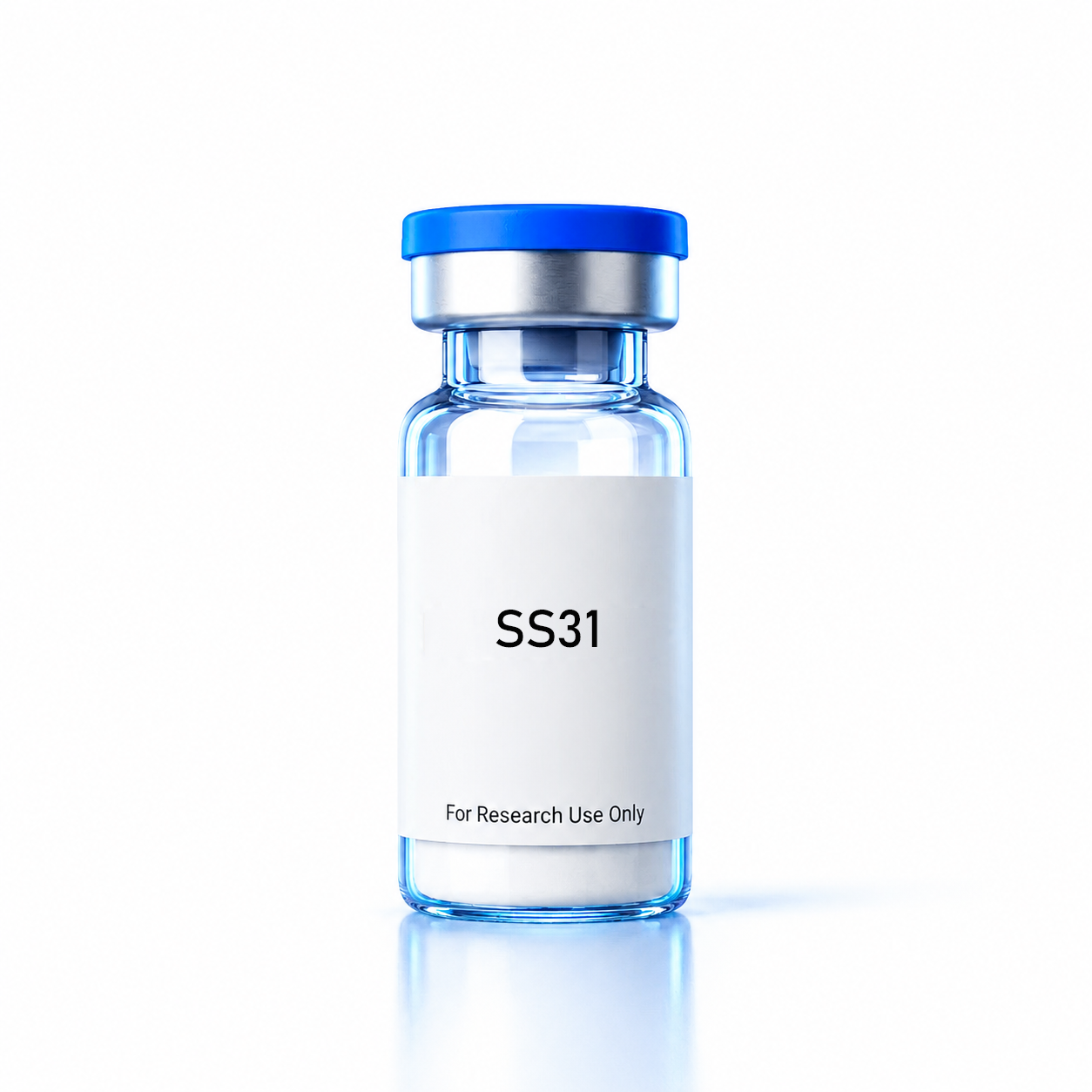
SS31 (Elamipretide / MTP-131 / Bendavia)
⚠️ Disclaimer: For Research Use Only. Not for human administration or clinical therapy.
Basic Information
- CAS No.: 736992-21-5 (free base);Acetate salt: 1334953-95-5
- Sequence: D-Arg-Dmt-Lys-Phe-NH₂ (Dmt = 2′,6′-dimethyl-L-tyrosine), synthetic aromatic-cationic tetrapeptide, Szeto-Schiller peptide (SS-series)
- Molecular Formula: \(\boldsymbol{C_{32}H_{49}N_9O_5}\) (free base)
- Molecular Weight: 639.79 g/mol
- Appearance: White to off-white lyophilized powder
- Solubility: Soluble in bacteriostatic water, sterile water and DMSO
- Storage: Lyophilized powder store at -20℃, protected from light and moisture. Avoid repeated freeze-thaw cycles. After reconstitution, refrigerate and use promptly.
Development Background
SS31 was discovered by Dr. Hazel Szeto and Peter Schiller at Weill Cornell Medical College. It is the most well-studied member of Szeto-Schiller mitochondrial-targeting peptides. It selectively accumulates in inner mitochondrial membrane. It was developed for mitochondrial oxidative stress research. Elamipretide is the generic name; also known as MTP-131 or Bendavia.
Mechanism of Action (Research Findings)
- Selectively binds to cardiolipin on the inner mitochondrial membrane, stabilizes mitochondrial cristae and electron transport chain supercomplexes.
- Reduces cardiolipin peroxidation, cuts down electron leakage and mitochondrial ROS generation.
- Improves mitochondrial bioenergetics and ATP synthesis efficiency.
- Inhibits mPTP (mitochondrial permeability transition pore) opening, reduces cytochrome c release and stress-induced apoptosis.
- Unique advantage: targets damaged mitochondria independent of mitochondrial membrane potential.
Research Areas
- Mitochondrial dysfunction & oxidative stress study
- Ischemia-reperfusion injury (heart, kidney, brain)
- Mitochondrial myopathy & rare mitochondrial disorder models
- Anti-aging research, skeletal muscle protection
- Retinal injury, sepsis and inflammatory tissue injury models






评价
目前还没有评价