

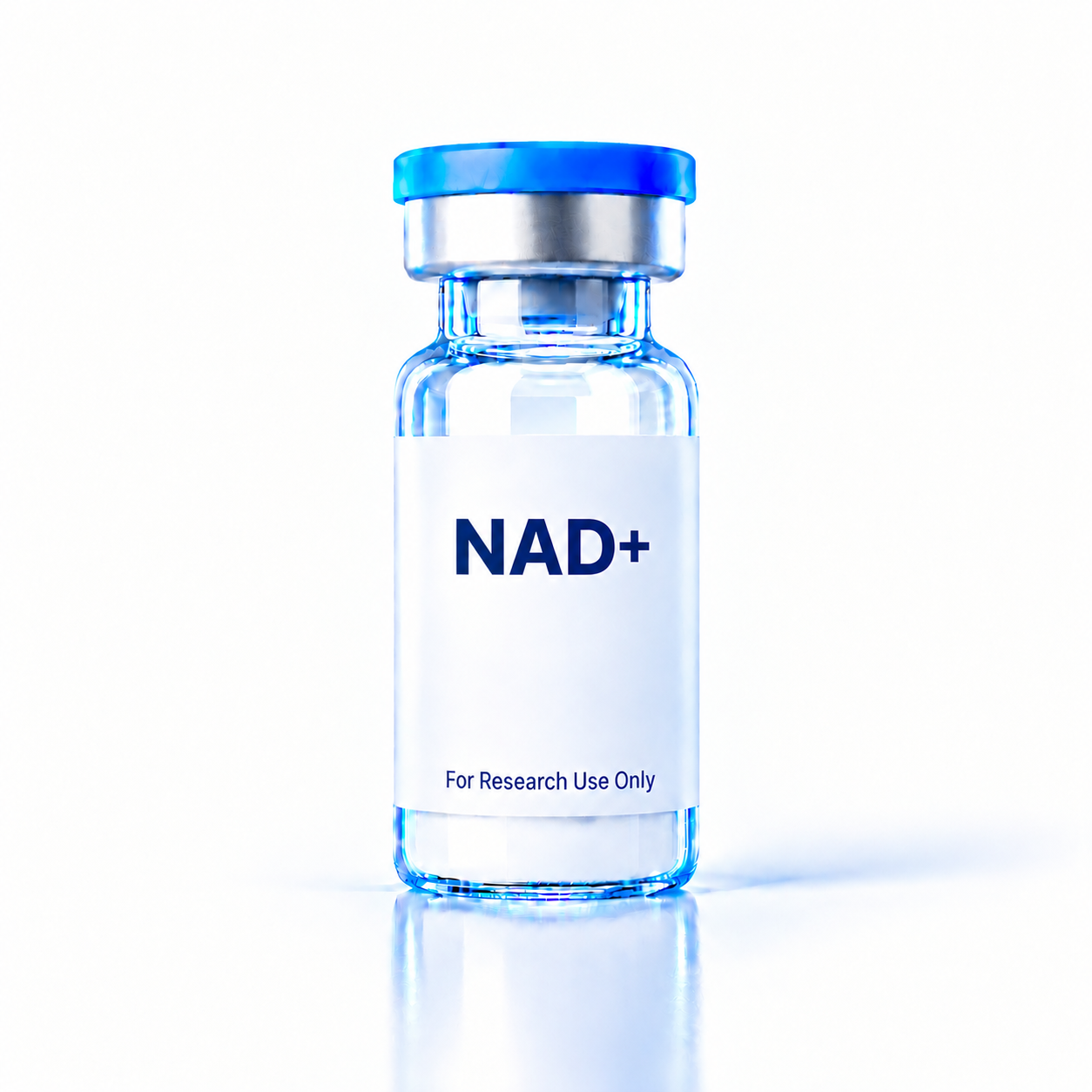
NAD+ (β-Nicotinamide Adenine Dinucleotide, Oxidized Coenzyme I)
CAS: 53-84-9
Aliases: β-NAD, Coenzyme I, DPN; not a peptide, but a dinucleotide coenzyme
> ⚠️ For laboratory research use only; not for human injection
Basic Information
– Full Name: β-Nicotinamide Adenine Dinucleotide (oxidized form)
– Molecular Formula: \(\mathbf{C_{21}H_{27}N_{7}O_{14}P_{2}}\)
– Molecular Weight: 663.43 Da
– Properties: White or off-white powder; highly hygroscopic; aqueous solution is slightly acidic, pH ≈ 3.0
– Structure: Composed of AMP and NMN linked by a pyrophosphate bond; in the oxidized state (NAD+), it accepts hydrogen to form NADH
Mechanism of Action (Core Research)
Four Core Biological Roles:
1. Redox coenzyme: Acts as a hydrogen carrier in glycolysis, the tricarboxylic acid cycle, and the respiratory chain, maintaining cellular energy metabolism through the NAD+ ↔ NADH cycle
2. Substrate for sirtuins (silencing information regulators SIRT1–SIRT7): Facilitates deacetylation, regulating aging, mitochondrial function, inflammation, and glucose and lipid metabolism
3. PARP family substrates: PARP1/2 DNA damage repair, which consumes NAD+
4. cADPR signaling precursor: calcium ion signaling regulation, immune cell function
>
> Research Highlights: Aging research; NAD+ levels in the body decline continuously with age; models of metabolism, neuroprotection, myocardial ischemia, and hepatic lipid metabolism
Physical and Chemical Properties & Dissolution Guidelines (Key Points: Rapid degradation upon exposure to alkalis or high temperatures; highly hygroscopic)
1. Solvents: Ultrapure water, PBS; alkaline buffers are not recommended; pyrophosphate bonds break rapidly in alkaline environments, leading to inactivation
2. Solubility: ≥50 mg/mL in water
3. Stability: Stable under neutral or weakly acidic conditions; rapid decomposition occurs upon exposure to strong alkalis, heat, or prolonged storage at room temperature
Storage Guidelines (Critical—highly hygroscopic and prone to degradation)
– Lyophilized powder: Store sealed, protected from light, and in a dry environment at -20°C; stable for up to 3 years; can be stored for 2 years at 4°C under dry conditions; strictly prevent moisture exposure
– Reconstituted stock solution: Aliquot and store at -20°C; use within 1 month; do not freeze-thaw repeatedly; storage at -80°C can extend shelf life to 6 months
– Working solution: Prepare and use immediately; store at 2–8°C for short periods
Research Combination Recommendations
– Aging + Mitochondria: NAD+ + Epithalon
– Metabolism / AMPK: NAD+ + AICAR
– Neuroinflammation and Repair: NAD+ + ARA290
– Tissue Remodeling: NAD+ + GHK-Cu
⚠️ Important Notice
1. NAD+ is intended solely for in vitro biochemical, cellular, and preclinical animal research; human injection is strictly prohibited.
2. It is highly hygroscopic; a controlled-humidity environment is required for packaging, aliquoting, and testing.
3. This information is provided solely as biochemical research material and does not constitute any guidance for human use.
评价
目前还没有评价